Photo: AEGIS Protect GmbH / KI-generiert
Video Surveillance During a Blackout: What Happens When the Power Fails?
When power, lighting, routers and local networks fail, the real resilience of a security system becomes visible.
What happens to your security technology when the power suddenly goes out?
Does video surveillance continue to work during a power outage?
The short answer is: only if it has been designed to do so.
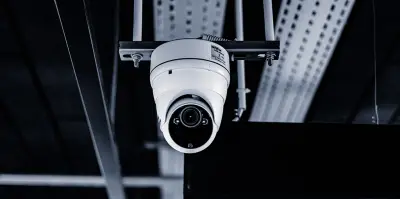
A camera needs power. With IP-based systems, additional components are often required as well: PoE switches, network equipment, routers, recording servers and, in some cases, lighting. If the mains supply fails and these components are not adequately backed up, a functioning video surveillance system can become a system without images or connectivity within seconds.
Professional systems can therefore be equipped with UPS or backup power solutions. However, the entire chain matters. A camera with backup power is of little use if the associated switch or router fails at the same time.
This is exactly where autonomous security systems differ from conventional building-dependent video surveillance.
Power outage or blackout – what is the difference?
Not every power outage is a blackout.
A local outage may affect only one building, a street or a relatively small area and may be resolved after a short period of time.
The term blackout, by contrast, is generally used for a large-scale and prolonged failure of the power supply. Germany’s Federal Office of Civil Protection and Disaster Assistance points out that while Germany has a highly reliable electricity supply, major and long-lasting outages cannot be completely ruled out.
For companies, however, the terminology is less important than one simple question:
Which security functions remain available once mains power is no longer available?
What happens to conventional security technology during a power outage?
That depends entirely on the individual security concept.
In a conventional IP video surveillance system, the following components may depend on mains power:
cameras
PoE switches
network distribution equipment
routers
internet connections
network video recorders
servers
monitors
external lighting
electric gates and barriers
access control systems
Professional security planning takes these dependencies into account from the outset. Nevertheless, it is still common for only the central alarm system to have backup power, while other elements in the security chain remain dependent on the building’s electricity supply.
A power outage should therefore not only be considered in terms of:
“Does our alarm system have a battery?”
The better question is:
“Which components do we need in order for detection, transmission and response to continue working?”
How does autonomous video surveillance work without a power connection?
The autonomous surveillance technology used by AEGIS Protect is designed differently.
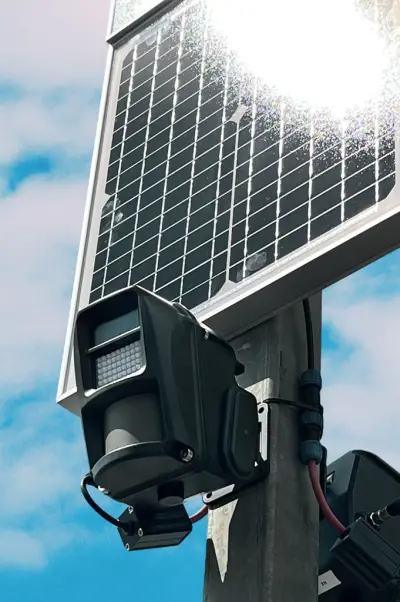
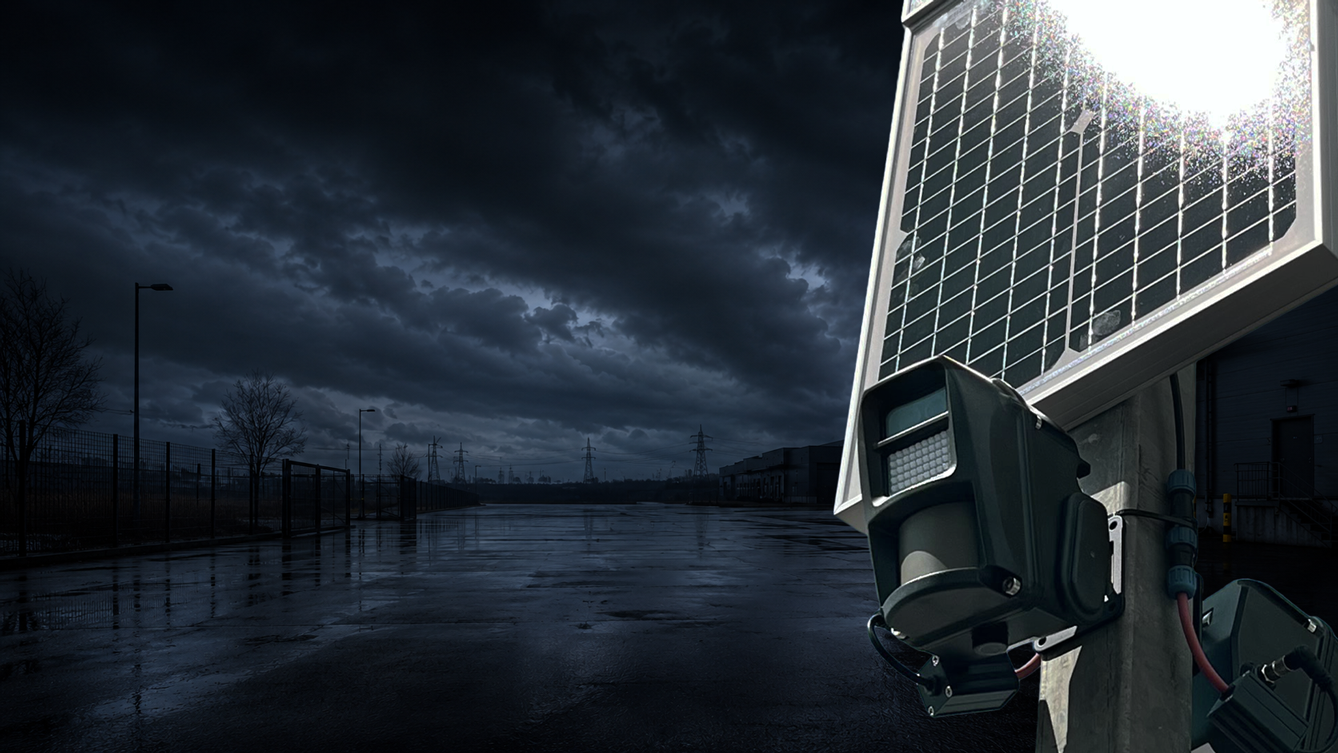
Detection devices and cameras do not require a power connection at the monitored site. The individual devices have their own power supply and communicate wirelessly with each other.
If relevant movement is detected within a monitored area, the detector activates the camera and records images of the event.
Communication with the monitoring platform takes place via a separate bridge and the mobile network.
This means that the system does not require the following infrastructure at the site:
a 230-volt power connection
the customer’s router
a DSL or fibre connection
an existing local network connection
the building’s PoE switch
A failure of the building’s power supply therefore does not automatically stop local detection.
What happens to our surveillance system if the power actually fails?
At first, surprisingly little changes for the autonomous system.
Detectors, cameras and communication components have their own batteries. They are not dependent on the power supply of the monitored building.
Motion detection can therefore continue to operate and the camera can continue to capture events.
For the detectors we use, the technical documentation specifies a battery life of up to 400 days in standby mode or up to 50,000 events. The communications bridge is specified with up to 150 days of standby time.
Actual battery life depends on factors such as the number of events, radio conditions, temperature, configuration and any solar support in use.
The point is not to promise operation throughout a months-long blackout.
The key difference is:
A failure of the local power grid does not automatically mean that the surveillance system fails as well.
Does alarm transmission continue to work during a blackout?
This requires a distinction between surveillance and alarm transmission.
As long as the mobile network remains available, the bridge can continue to transmit alarm data via mobile communications. The monitored company’s own internet connection is not required.
This is a significant advantage during a local power outage. While routers, networks and possibly the site’s conventional video surveillance may already have failed, an autonomous system can continue communicating via the mobile network.
During a large-scale and prolonged blackout, however, the situation changes.
Mobile networks also require electricity.
How long does mobile coverage continue during a blackout?
There is no reliable general answer such as “four hours” or “eight hours”.
Germany’s Federal Office of Civil Protection and Disaster Assistance explicitly points out that mobile networks depend on electricity. During a power outage, they may continue to operate for a limited period of time. At the same time, network congestion may occur because large numbers of people switch to mobile communications.
Not every mobile base station has the same backup power arrangement. Unprotected infrastructure may fail early, while other sites may continue operating for longer using batteries or additional emergency power.
The correct conclusion is therefore:
Mobile communications can remain available during a blackout, but they cannot be treated as guaranteed infrastructure for an unlimited period.
This distinction is important when compared with claims such as “our surveillance system works completely independently during a blackout”.
That would be too broad.
The system is independent of mains power at the deployment site, but real-time transmission still depends on an available communication path.
What happens to alarm images if the mobile network fails?
This is where local storage becomes particularly valuable.
The detectors used by AEGIS Protect also store captured images locally on the device. The technical documentation specifies 7.6 GB of internal storage for more than 1,800 full-resolution images.
If the connection is temporarily unavailable, recorded events are therefore not automatically lost.
The images remain stored locally and can be transmitted once connectivity becomes available again.
In practical terms:
Power unavailable, mobile network available:
Detection, recording and alarm transmission can continue.
Power unavailable, mobile network temporarily unavailable:
Detection and local recording can continue. Immediate alarm verification by the monitoring centre is not possible while the connection remains unavailable.
Mobile network restored:
Buffered images can be transmitted afterwards.
This distinction is important. Local storage preserves documentation, but it does not replace real-time intervention during a complete communications outage.
Why is a blackout particularly relevant to physical security?
A power outage does not only affect cameras.
Other protective systems may also become restricted at the same time:
external and internal lighting may fail
electric gates and barriers may change operating state
network equipment may stop functioning
building management systems may be limited
access control systems may switch to emergency operation
permanently installed cameras may fail
communication channels may become restricted
This changes the overall security situation of a site.
When considering large-scale blackout scenarios, the VDE also points out that video surveillance and other technical systems may be affected.
Security concepts should therefore not be designed solely for normal operating conditions.
The key question is:
What remains operational when the infrastructure on which the security concept normally depends is suddenly unavailable?
Autonomous security technology reduces dependencies
Complete independence from all external infrastructure is practically impossible.
Dependencies can, however, be reduced.
A conventional camera system may simultaneously depend on building power, the local network and the site’s internet connection.
An autonomous system separates several of these dependencies:
Power supply: its own batteries and, where applicable, solar power
Detection: directly at the monitored area
Image capture: locally at the detector
Local storage: recordings remain available even if the external connection fails
Communication: mobile network instead of the customer’s router and fixed internet connection
This creates a security solution that can continue providing key functions even when several other systems at the site have already failed.
Particularly relevant for remote and critical areas
The advantages of autonomous surveillance are not limited to a large-scale blackout.
Even a local power outage can become a serious security issue for certain sites.
Typical applications include:
construction sites
industrial and commercial sites
logistics facilities
energy infrastructure
electrical substations
solar parks
storage areas
critical infrastructure
remote technical facilities
temporary construction areas
vacant properties
sites without existing power or network infrastructure
Autonomous surveillance can be especially useful where security should not depend on infrastructure that already exists at the site.
Can deliberately switching off the power disable the surveillance system?
In a system that is entirely dependent on building power, interrupting the power supply can become relevant if no adequate backup power solution exists.
With an autonomous system, switching off the building’s electricity does not initially affect the power supply of the detectors.
This is relevant not only in the event of a large-scale blackout.
It can also be useful during:
electrical installation work
shutdown buildings
vacant properties
refurbishment projects
technical faults
undeveloped sites
The surveillance system can continue to operate independently of the available mains connection.
Does that make a UPS unnecessary?
No.
Autonomous surveillance and professional backup power solutions serve different purposes.
For permanently installed security systems, a properly designed UPS or emergency power supply may be exactly the right solution.
At larger sites, several approaches can also be combined.
For example:
Building: fixed video and intrusion detection systems with backup power
Outer perimeter: autonomous detection
Temporary areas: mobile autonomous surveillance
Alarm handling: connection to a monitoring centre
The objective is therefore not to replace existing security technology across the board.
The important thing is to identify critical dependencies and create redundancy where it is actually required.
What happens to monitoring centre connectivity during a blackout?
As long as a functioning communication path exists between the system and the monitoring centre, alarm events can continue to be transmitted and processed.
If the mobile network fails completely, real-time transmission via this channel is no longer possible.
A monitoring centre can only respond to information that actually reaches it.
For particularly critical applications, planning should therefore consider:
Which communication channels are available?
Are alternative transmission paths available?
How long do they need to remain operational?
Which functions must continue locally without external communication?
What procedures apply during a prolonged communications outage?
Does physical on-site security need to be increased?
The higher the required level of availability, the more important it becomes to consider the entire security chain rather than individual components.
Blackout resilience starts with a simple assessment
Companies can relatively easily determine how dependent their current security technology is on the electricity grid.
1. Check the power supply
Which components fail immediately when mains power is interrupted?
2. Check the network
Do cameras or alarm systems depend on the building’s router, switches or internet connection?
3. Check backup power
Which components are actually backed up – and for how long?
4. Check alarm transmission
Does the connection to the monitoring centre continue working if the local internet connection fails?
5. Consider mobile communications
What happens if the mobile network becomes restricted in addition to electricity and internet access?
6. Define local functions
Which detection and documentation functions must continue independently of an external connection?
7. Define a response plan
What happens if a site remains disconnected from the monitoring centre for several hours?
Only once these questions have been answered can the actual resilience of a security concept be assessed.
Blackout-ready does not mean invulnerable
Realistic claims are particularly important when discussing security technology.
An autonomous system can significantly reduce dependence on local power and network infrastructure.
It can continue detecting movement and capturing images even when no mains power is available at the site.
It can transmit alarms via mobile communications for as long as the mobile network remains available.
And it can store events locally if connectivity is temporarily interrupted.
But autonomous systems also have limits.
If all communications networks fail for an extended period, immediate transmission to the monitoring centre is no longer possible. Battery capacity is also finite.
A robust security concept acknowledges these limitations rather than ignoring them.
What does your security technology do when the power goes out?
This question should not be answered for the first time during an actual outage.
For construction sites, industrial facilities, logistics areas, energy infrastructure and remote locations in particular, it may be sensible to separate important security functions from the local power and network infrastructure.
AEGIS Protect uses autonomous detection and video surveillance systems that can operate without a power connection and without using the customer’s internet connection.
Movement is detected directly within the monitored area, events are documented visually and – for as long as a communication path remains available – transmitted for alarm verification.
This does not make security completely independent of the outside world.
But it makes it significantly less dependent on precisely the infrastructure that may be among the first things to disappear during a power outage.

Security that builds trust.
Welcome to AEGIS Protect, your reliable partner for comprehensive protection and security. Our goal is to give you a safe environment where you can feel relaxed and protected. With years of experience, modern technology and a team of professional security specialists, we meet your security needs reliably and efficiently. Count on us for round-the-clock protection wherever you need it.