Photo: AEGIS Protect
Unauthorised entry to construction sites: risks and protection after working hours
Clarify access, secure hazards and assess alerts – without treating every person as a suspect.
Not every entry is an attempted theft.
Why unauthorised entry is a problem even without theft
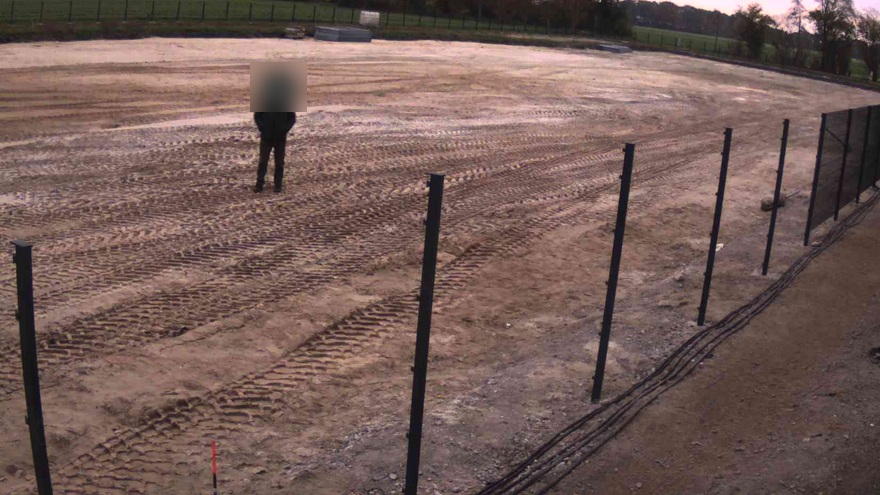
A person walks across the site after working hours. No theft can be seen in the images. Nevertheless, the alert should not simply be dismissed as harmless: whether someone is allowed to be there and whether there is a danger are different questions from that of a possible intention to steal.
Depending on the construction phase, a site may have open trenches, fall edges, temporary routes or unsecured components. In the dark, such hazards may be harder to see. Even an apparently clear area is not automatically a safe way through.
This does not mean that every person on a construction site is committing a crime. An image initially shows only a section of the scene. It explains neither the intention nor reliably the authorisation to be there. That is why detection, verification and an appropriate response belong together.
For site managers and project managers, the practical question is: how do we prevent unauthorised entry – and how do we act if someone is on the site anyway?
Is a “No entry” sign enough?
A prohibition sign makes it clear that the construction site is not a public thoroughfare. But it does not lock a gate, close a gap in the fence or secure a fall edge. Which actual protective measures are necessary must be assessed on the basis of the site and its hazards.
Section 9 of DGUV Regulation 1 (the German statutory accident insurance’s accident prevention regulation) obliges the employer to ensure that unauthorised persons do not enter parts of the operation if this creates a danger to safety and health. This is a preventive duty; it does not automatically determine who is liable under civil law for a specific accident.
For organisation after working hours, these points are particularly useful:
Clearly define access points and site boundaries; take necessary escape routes into account.
Check gates and barriers for their actual condition, not just their planned position.
Secure dangerous areas appropriately for the current construction phase.
Define who checks that the site is closed after the last trade has left and reports defects.
Agree special access such as late deliveries in advance.
A sign is therefore one element, not a blanket exclusion of liability. Conversely, it cannot be claimed that every accident involving an unauthorised visitor triggers liability on the part of the client.
Who is liable in the event of an accident – and what applies to insurance?
Distinguishing safety obligations from personal responsibility
Put simply, the duty to maintain safety (Verkehrssicherungspflicht) means: anyone who creates a source of danger or is responsible for it must take the protective measures that are necessary and reasonable in the circumstances. Which tasks the client, the construction company or other parties take on must be clarified for the project. Responsibility should not only be agreed, but also put into practice day to day.
Section 823 of the German Civil Code (BGB) governs the obligation to pay damages for the culpable violation of protected rights. For a specific claim, what matters includes the existing duty, its breach and the connection with the damage. Under Section 254 BGB, the injured party’s own conduct can reduce the claim or, in individual cases, exclude it.
How important the circumstances are is shown by a decision of the Higher Regional Court (OLG) Hamm of 29 October 2013, 9 U 135/13. The case concerned a cyclist in a construction site area closed off by barriers and traffic signs. The court rejected his claim and emphasised the limited safety obligations towards unauthorised persons. At the same time, it named exceptions where those responsible had to expect unauthorised persons, and special requirements for the protection of children.
It follows neither that “a sign is always enough” nor that “you are always liable for unauthorised persons”. Rather, repeated entries should be a reason to review access points, hazards and safety measures again.
Insurance cover is a separate question
Whether someone is liable and whether an insurer covers a loss must be examined separately. An alert about unauthorised entry proves neither an insured loss nor the loss of insurance cover.
What matters is the specific contract, the insured risks, exclusions and agreed obligations. The German Insurance Association (GDV) expressly points out regarding its model liability insurance conditions that they are non-binding and that deviating agreements remain possible.
So clarify with your insurer or broker which safety measures, notifications and records have been agreed for your construction project. Neither a fence nor a camera nor an alarm log on its own guarantees an insurance payout.
What should happen after an entry alert?
Sensible alarm handling begins with assessment, not with prejudgement. At AEGIS Protect, the alarm receiving centre verifies the alert and works through the agreed response plan. Depending on the situation, this includes consultation with the contact person and any necessary security response on site. The police are called in if there are signs of a crime or danger, not automatically for every person detected.
For planning, four questions should be answered:
When is entry planned? Working hours, special permissions and changes must be known. “After working hours” does not automatically mean “unauthorised”.
What can be recognised? Position, direction of movement and visible hazards help with the assessment. Intent cannot be reliably established from images alone.
Which measure suits the situation? A possibly authorised subcontractor, an unclear entry and a recognisable emergency must be handled differently. Addressing the person via loudspeaker or sounding a siren is not a blanket standard response for every case.
What is recorded? Observations, queries and measures taken should be documented objectively. Assumptions do not belong in the log as facts.
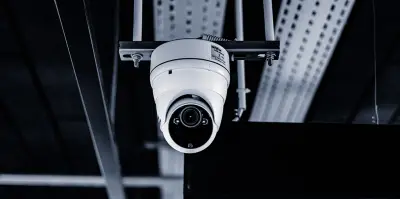
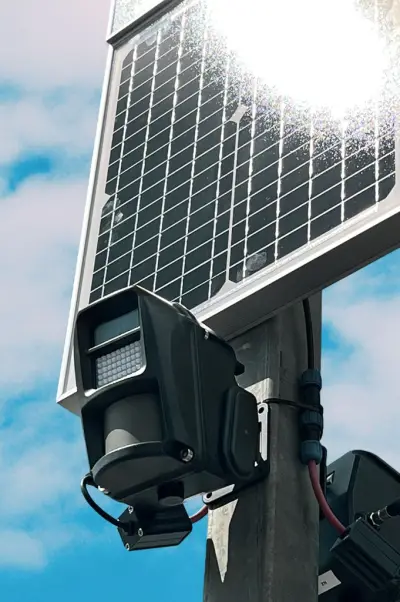
Where there is no power connection or fixed internet line, self-powered detectors can forward events with image material via radio and the mobile network. Network coverage, power supply and coverage areas must suit the location. The technology can detect entries and enable an assessment; it replaces neither barriers nor the securing of specific hazards. Data protection and limiting the areas covered also belong in the planning.
End-of-day checklist for site managers and project managers
Check the construction status: Which new hazards or changed routes have arisen today?
Check the boundaries: Are gates closed, fence panels intact and temporary openings secured again?
Secure hazardous areas: Are the necessary barriers and covers in place?
Coordinate access: Who is still allowed in later, and who knows about it?
Keep the alarm plan up to date: Have contact persons, availability and the procedure for unclear entries been defined?
Adjust the technology: Do coverage areas and alarm times still match the construction phase?
Document defects and incidents: Who closes a gap, and who then checks that the site is closed?
Not every unauthorised entry is an attempted theft. Nevertheless, it is a reason to clarify authorisation and possible hazards. The right protection combines actually securing the site with clear responsibilities and an assessed response.
When it comes to stolen tools, machinery or materials, our article Theft on construction sites: who is liable and how to protect yourself? covers the other side of construction site protection. For buildings that are unused for long periods, you will find the measures in the article Securing vacant buildings.
Note: General overview for Germany, as of 8 November 2026. This article does not replace a legal or insurance-contract review of the individual construction project.

Security that builds trust.
Welcome to AEGIS Protect, your reliable partner for comprehensive protection and security. Our goal is to give you a safe environment where you can feel relaxed and protected. With years of experience, modern technology and a team of professional security specialists, we meet your security needs reliably and efficiently. Count on us for round-the-clock protection wherever you need it.